Ads 468x60px

Labels

Social Icons

.
Showing posts with label Communications. Show all posts

Marriott wants you to vacation on a virtual beach

Source: Marriott Hotels
Marriott Hotels is betting the future of travel will be, at least in part, virtual.
The hotel brand is rolling out the Oculus Rift technology at select hotel locations to enable guests to virtually explore the black sand beaches of Hawaii or the city of London. 
But to make the experience more immersive, Marriott is taking things one step further by adding in sensory elements such as heat, wind and mist.
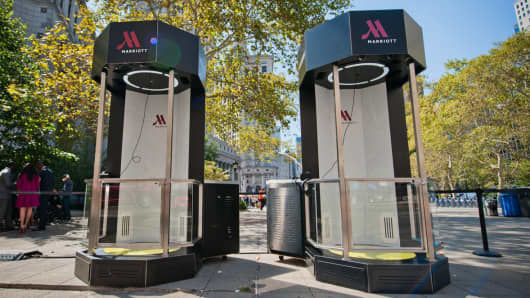
The program works like this: A person stands in a phone-booth like structure dubbed the Teleporter, puts on the Oculus Rift virtual headset and wireless headphones, and is then "teleported" to the destination.
The Teleporter has built in 4-D technology that makes it so the user physically feels different parts of the environment, such as temperature and moisture. 
While Marriott claims this is the first time these technologies are being applied for a travel experience, the idea of using virtual reality for travel is nothing new. 
In June, Second Life CEO Philip Rosedale said at the Singularity Finance Conference that it won't be too long before people actually purchase a virtual reality (VR) property so that they can visit it anytime they want. 
Given how much momentum, there's been in the VR space this year, Rosedale's prediction may not be too far fetched.
In March Facebook shelled out $2 billion to purchase Oculus Rift's technology. And in June Google revealed Carboard, its own open-source mobile-powered virtual reality headset. Samsung recently rolled out its Gear VR headset, which is also powered by a smartphone (specifically the Galaxy Note 4), but it has tapped Oculus Rift to handle the software.
While it's become the norm for tech giants to jump into the VR space to grow their gaming and entertainment ambitions, a traditional hospitality company like Marriott Hotels may seem like an odd fit to be using the technology.
But the company sees the virtual world as a big opportunity to breathe new life into its brand and possibly even spur new business.
"It's part of our transformation message," said Michael Dail, the vice president of brand marketing for Marriott Hotels. "This isn't the Marriott you once thought of."
Dail said that while a long-term VR strategy hasn't been determined for the company, the possibilities are endless.
For example, if someone is planning a vacation, they could use VR technology to check out different destinations before booking a trip, Dail said. It could also be used in hotels to transport guests to new locations, he added.
"It can inspire their decision of where they want to go and it could also be used to enhance their stay," Dail said.
Marriott is kicking off its virtual travel experience Thursday at the Marriott Marquis in New York City, but the Teleporters will be traveling through November at select locations around the country.
"We can be disrupted to ourselves," Dail said. "We want to take things to the next level and we are thinking ahead about the future of travel."

SKULLY AR-1: Rebel Innovation

Paperfold is a foldable, transformable smartphone prototype


If Kyrocera's folding smartphone Echo didn't have enough screens for you, try this on for size. The Human Media Lab at Canada's Queen's University has created a fully functional smartphone that uses not two, but three different snap-together e-ink displays. The result is a gigantic device called PaperFold, that can do some pretty awesome stuff, especially with maps. You can display driving directions over all of the screens for easy planning, or fold the displays together to create a Google Earth globe of sorts. The phone can even be used to print a model of your office. Just connect the panels together into a building-like shape, and send the specs along to your local 3D printer. A pretty cool trick if you ask us.

PaperFold

See all photos
7 Photos
The inspiration for the project came from, you guessed it, paper. The lab's director, Dr. Roel Vertegaal, says "the development of electronic paper computers that can adopt similar qualities to paper has been an enduring research goal" for his team. It's an aspiration that's not unique to just this project. In 2010 Microsoft was working on (and then killed) a book-like tablet called Courier, and Sony released a high-dollar digital paper tablet earlier this year. While there are no plans to bring PaperFold to market just yet, it shows us what could be possible with digital displays and e-ink technology. Want to take a look for yourself? Check out the video below for a look at the prototype in action.

BLU's latest smartphone is big, cheap and contract-free

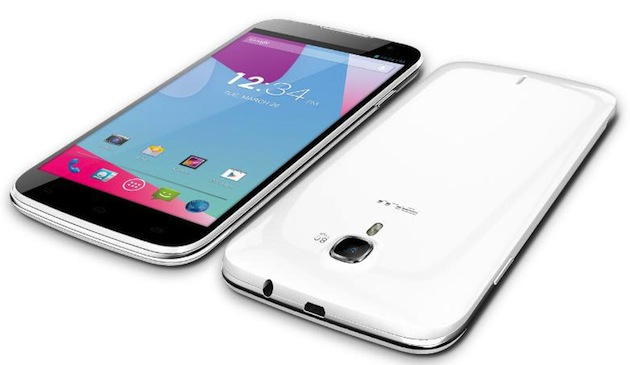
BLU Products Studio 6.0 HD (PRNewsFoto/BLU Products)
When it comes to offering a vast selection of Android smartphones on the cheap, BLU Products is a company that quickly comes to mind. And now we can add another one to its budget-friendly lineup: the Blu Studio 6.0 HD. As its moniker would imply, this is a 6-inch handset, with a 1,280, x 720 display, a quad-core, 1.3GHz chip (Mediatek MT6582, if you're so inclined) and a decent 3,000mAh battery inside. Perhaps what's most interesting here, however, is that the 6.0 HD will be available unlocked for a mere $250, which is a great price if you're looking for a phone this size and not interested in any carrier contracts.
BLU has made itself known for bringing a ton of different options to market. We're talking smartphones like the Studio 5.5, which sells for $179 off contract; or the $349 Life Pure, which is also unlocked and sports a 5-inch, 1080p screen. Just don't expect the BLU Studio 6.0 HD to be running the latest and greatest version of Android, since it's set to come with 4.2.2 when it starts shipping next month.

You can now use the iPhone for free, as long as you don't mind old gear

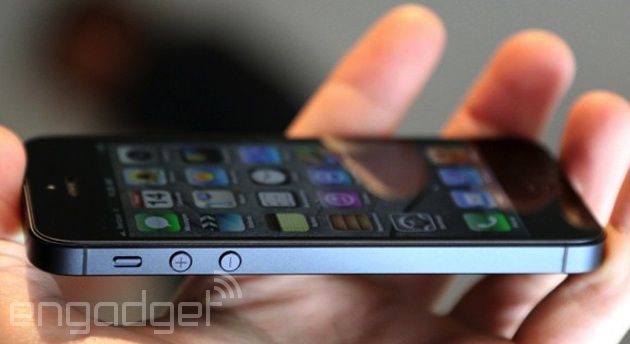
iPhone 5 on its side

To date, FreedomPop's no-cost phone service has been attached to older Android phones. That's fine for many, but not exactly diverse. Your choices are a little better now that carrier has added iPhone support to its lineup, though. You can get 200 voice minutes, 500 messages and 500MB of data per month on Apple's handset without paying a dime; it costs the equivalent of $5 per month if you need unlimited calls and texting. It sounds great, so what's the catch?
As you might suspect, device selection is the big gotcha. Much like Ting, FreedomPop isn't carrying the latest Apple technology. You'll have to be happy with either buying a refurbished iPhone 5 for $349 or bringing over a Sprint-ready iPhone 4, 4S or 5 you already own. This isn't the choice for those who want to live on the bleeding edge, then. Still, it does give you free LTE phone data -- a major advantage when the only alternative on FreedomPop with similar speeds is a hotspot.

Google and NASA's Quantum Artificial Intelligence Lab

Anonymous' New Walkie Talkies Use Radio Waves to Access the Internet

Image: Lulz Labs/Vimeo

The hacktivist group Anonymous is working on a new communication tool to circumvent censorship and set information free, and it’s going low-tech this time. The project is called Airchat, and it will use radio waves instead of wifi, broadband, or phone lines to communicate data and messages between computers. It’s basically pirate radio for ones and zeros.
The idea for Airchat was hatched because of the “lessons learned in the Egyptian, Libyan and Syrian revolutions, but also from the experience of Occupy Wall Street and Plaza del Sol,” explains the project description on Github, posted under “Lulz Labs,” which was spotted by International Business Times. With social upheaval in Ukraine and Venezuela and other places around the world, a safe anonymous way for dissidents to organize movements and share information is as relevant as ever.
The radio communication works much like a walkie-talkie or CB radio, with the transmitter acting as a sender and receiver—only you’re sending computer commands instead of audio.


This kind of radio data transfer has been done before. The concept has existed since ALOHAnet was introduced in 1971, a University of Hawaii project that sent data over radio. In 2010, a startup called OneBeep created software that transferred data over radio waves by converting it into an audio signal and then back to the original information packets for the computer to translate.  
The team also experimented with laser light-based transmissions, a more complicated method of transmitting data through the pulse of a laser beam, but decided to put a pin in that for now.
Beyond political dissidence, the group writes that Airchat could be used for disaster relief, by support groups or medical teams, or by sailors to communicate weather conditions out at sea. Basically, it could be used any time you need information and traditional communication methods are down.
The end goal is to make this all available for free—“free as in 'free beer' and free as in 'Jeremy Hammond must be freed,” the group writes—without the control of megacorporations or heavy-handed governments.
"Even after all these years of technological advance, we still need to meet in common public places to continue expressing ourselves in a free way," they write.
We’ve seen apps like Zello play a major role for rebel groups in Venezuela and Ukraine, becoming the go-to walkie talkie app that gave protesters the ability to communicate in private voice messages on the go. The problem with Zello, as was witnessed in Venezuela, is that it can only run using wifi or a data plan. With Airchat, which will use both encrypted and non-encrypted radio waves, that shouldn’t be an issue.
In its current incarnation, the project uses Fldigi software to communicate data—it’s the software commonly used to broadcast amateur radio stations from a computer. The machine’s sound card controls most of the communication of information to and from the transmitter using audio-frequency signals. It typically works on Linux, OSX, and Windows.
The radio transmitter is operated by keyboard commands, and Airchat can be programmed to let you send messages, access Twitter streams, download, news, or find community related articles, the group writes. For extra security, the program will is capable of using anonymous Tor servers and proxy support.
So far, they’ve had trouble transferring images via Google's WebP format, due to lack of browser support, but they’re still working out the kinks.
As it currently exists, as you can see in the Vimeo video posted this week, the program is still quite technical for everyday folk. At this point Airchat is still a proof of concept, and the group is releasing early information about it to try to rally community support and funding.
But it’s already been used by Anonymous to play chess with people 180 miles away, share images and communicate “encrypted low bandwidth digital voice chats.” They have also accomplished 3D printing at distances over 80 miles and have been able to send medical orders at distances over 100 miles.
It works, but it doesn’t operate at high-speeds, and the clarity of the connection depends on the strength of your radio signal. As the group writes, it “sacrificed bandwidth for freedom.”
TOPICS: free the network, hacking, Anonymous, censorship, radio, airchat, power

How the ‘Outernet’ Plans to Broadcast Free Internet from Space

How the ‘Outernet’ Plans to Broadcast Free Internet from Space
When the Outernet project was first announced in February, some commenters on the web figured it was a scam. The plan does have a certain pie-in-the-sky utopian ring to it: thwarting censorship and ensuring information as a human right throughout the globe by beaming crowdsourced content from nanosatellites in outer space, funded by VC seed money and user donations.
Really?
But the plan, while ambitious, is quite serious, and the many moving pieces are progressing along, Outernet founder Syed Karim told me over the phone yesterday. He dismissed the naysayers: "I mean, why does it matter if someone thinks it's not feasible. Why not just wait and see? Why get into a debate on something that will eventually prove itself out?"
To be clear, the idea here isn't another Facebook/Google-style effort to carry internet access through the sky to the last mile on drones and balloons. Not exactly. Karim describes it as mix between modern-day shortwave radio and BitTorrent from space. It's a media company, seeded by the Digital News Ventures investment firm, and the goal is to provide access to content, information, apps, and tools—free—to every global citizen.
The shortwave radio comparison is apt. Shortwave frequencies helped localize radio so you could tune in from anywhere, even in rural areas in the middle of nowhere. Now take that concept and add multicast web content, and replace radio towers with a satellite constellation in low orbit, and you start to get a sense for how the Outernet would work.
It would start as a one-way broadcast; users could interact with websites sent on Outernet's channels, but not access the whole web. Karim has a vague plan to let the users dictate the content that's provided, not a team of editors acting like gate-keepers. Users could request the information they want to see—say a farmer in Bangladesh wants to learn more about the weather conditions and crop prices for the rice he's growing—through the Outernet Facebook page, and the team will look for trends and common topics to help decide what channels to broadcast.
Seem a little half-baked? That's because it is. At this point, the team is thinking less about content curation and more about how to build the space satellite-based broadcast distribution system in the first place.
"The goal for the alpha constellation, something that could theoretically be deployed in two years, is for 24 satellites across 4 orbital planes," said Karim. That's a Roomba-style satellite constellation, with six satellites per plane, enough "to offer more or less continuous global coverage, with some hiccups in here and there," he said.
Image: Outernet

He's talking to SpaceX to negotiate a price for launching the microsats into orbit, which will be the most expensive chunk of the Outernet pie in the sky. In a Reddit forum in February, Karim said that SpaceX's bulk rate for launching microsatellites is $57 million for 13,000 kg. While this is just a fraction of what traditional communication satellites cost, it's hardly chump change. He declined to get into pricing details over the phone, only to estimate it would cost less than $10 million for the entire Outernet project to become fully operational.
Karim has also reached out to the International Space Station to request time onboard to test the system, and expects an answer by June.
In the meantime, the team is working on building their own microsatellites to send into orbit, and receivers to spread throughout the ground—they're currently crowdsourcing design ideas on CrowdSPRING.
Sixty percent of the planet still lives outside the internet infrastructure, and this is where the Outernet equipment comes in. The receivers will sell for about $100 each, which Karim hopes will create a network of thousands of beam spots. Outernet content would also be transmitted from ground stations to wi-fi routers or smartphones.
Those transmissions would be open and beamed globally, which Karim argues would help secure the connection against jamming or other censoring attacks, though "security is a tough nut,” he admitted. “I can't say this is a bulletproof solution. If someone is hell bent on taking something down, be it a hacker or government agency, I can't assure that they won't succeed."
You can think of Outernet transmissions like open-source code, he explained. "There's no malware in Ubuntu because you have thousands of developers constantly reviewing the codebase," he said. "Censorship is something a little different. A bad actor could jam the signals, but this would have a localized effect. I am not aware of anyone being able to jam multiple spot beams all over the world."
Karim, who described himself as a "failed economist and a failed librarian," has been studying the social and economic impact of internet access for years, and believes he’s finally arrived at a workable solution that can be pulled off at a relatively low cost. He said the seed funding from Digital News Ventures would be enough to test the first broadcast, and if the company grows the way he's hoping—to tens or hundreds of millions of users—it would try to turn a profit the same way any other media company does—namely, by selling ads.
That's a long way off. According to the timeline on the Outernet website, the plan is to develop prototypes by June, start the first data broadcasts by July, begin transmission testing on the space station by September, and be up and running by summertime next year. "This means that by July, you can stick any Ku-band satellite dish—the kind you see all over Asia and Africa—and receive broadcast data from Outernet," said Karim.
Outernet still has a lot of hurdles to clear to prove it’s possible: getting bandwidth, building its proprietary microsats, striking a deal with SpaceX to launch its payload, getting approval from the ISS, cherry-picking from millions of webpages to program content, and finding a way to pay for it all.
TOPICS: Futures, microsatellites, free the network, space, outernet, Internet

What to Leave in Your Digital Legacy

What to Leave in Your Digital Legacy

Death might be getting more digital, but our living legacies are lagging behind. When you’re lying in your smart grave after your high-tech autopsy, what happens to the digital life you spent so much of your physical life building? Your digital self—in the form of online accounts, social media, even gaming avatars—doesn’t necessarily die with you, but unless you leave some kind of after-death instructions, it could be thrown into virtual limbo.
The Law Society of England and Wales is urging people to leave a digital legacy after their death, by leaving instructions for their digital assets, just like you’d include physical stuff in a will.
The rules around digital assets aren’t quite as simple as stating a solemn dying wish that you’d like to leave all your ones and zeros to your cat, but there are certain instructions you could consider. I spoke to solicitor Gary Rycroft, who’s a member of the Law Society Wills and Equity Committee, about the different kinds of digital material you might want to pass on.
First up is online banking accounts. The money in them will go into the pot with any other bank accounts, but the problem is that whoever’s dealing with your assets might not even know they exist, and they’re not going to get a paper statement through the post to alert them to your precious digital stash. “You need to be aware of your online investments and somewhere keep a log of them, keep a schedule of what they are, so that whoever’s sorting things out afterwards is able to trace what’s in your estate,” said Rycroft. “Because otherwise assets are at risk of being lost—overlooked.”
But banking is just the tip of the iceberg when it comes to the myriad online accounts we possess. Personally, I don’t really care what happens to my social media accounts after I’m dead—because I’ll be dead—but I guess some people are more attached to their carefully honed Facebook and Twitter presences, even beyond the grave. Presuming you haven't already arranged to post updates from six feet below,Rycroft suggested you could leave instructions as to what should happen to your profiles, like if they should be completely deactivated, or kept frozen as a sort of memorial page.
Facebook actually updated its own guidance on the matter a couple of months ago; where profiles used to be closed off to friends only after a user died, they’re now kept in the same state as if the person were still alive. “This will allow people to see memorialized profiles in a manner consistent with the deceased person’s expectations of privacy,” the company’s community operations team wrote.
The main point is to leave a list of all your digital accounts—well, the ones you want your parents/kids/significant others to know about—so they don’t go forgotten. But the Law Society advises that you shouldn’t leave passwords as they’ll probably go out of date before they’re needed, and in some cases it might actually be illegal for someone else to access your account.
It gets more complicated with libraries of digital books, music, films, and so on, as in many cases you don’t actually own these; you only license them. “The present position seems to be with books and music that they really are at risk of being lost on death, because you can’t actually pass them on to other people,” Rycroft said. I asked him if you couldn’t just, say, shove them all on one device and pass that on. He said that might be an idea, but the recipient wouldn’t be able to move the files off the device. And again, passing on any passwords could potentially get them in trouble with the Computer Misuse Act 1990. “There’s perhaps more questions than answers in that area, to be honest,” he said.
The same may be true for gaming avatars; do you actually own that character that you spent so many sleepless nights pushing to the highest ranks and levels, or do you just have permission to use it a while? “It would very much depend on what you signed up to in the first place,” said Rycroft. “It all boils down to that bit on screen that we all scroll through and tick, ‘I agree.’”
And when it comes to the million-bitcoin question of cryptocurrencies, Rycroft said he wasn’t able to give specific advice for what you could do to pass them on after death—which seems fair enough, given that the law can barely decide what a bitcoin even is right now. Wayne Parker at Trade Block lists a few ideas of how you might technically be able to pass on a wallet, but aside from copying your whole wallet before you die, they’re not exactly simple; after all, you usually really don’t want anyone else to get that kind of access. 
Rycroft suggested, however, that you at least mention any cryptocurrency assets in your will to cover your bases. The general idea of the Law Society’s announcement, he explained, was to make people—and solicitors—aware that they should be thinking about digital assets when arranging their estate. “If you make a will and name executors then at least you are directing your assets, whether they are in the real world or the virtual world, to your chosen beneficiaries,” he said. 
Of course, if you’re an optimistic transhumanist, then by the time you come to consider your digital legacy, death might not be a thing and your brain might only exist in digital form anyway. But it’s probably best to make plans just in case.
TOPICS: death, wills, Social Media, power, Law, money

Facebook In Talks To Buy Drone Maker Titan Aerospace

The Exchange

Your information for sale: the illicit online marketplace

There’s a lot of information for sale on the Web's black market – and some of it might belong to you.
View gallery
.
.
Adding to an endless series of reports on Internet security breaches, cybersecurity firm Hold Security LLCrevealed this week that it discovered stolen credentials from some 360 million accounts available for sale on the underground Internet. Although it’s unclear now where the attacks were focused, the information unearthed includes user names and largely unencrypted passwords that could lead to anything from online bank accounts to huge corporate networks. Hold Security last year uncovered a massive hack at Adobe Systems that surfaced tens of millions of email addresses and encrypted passwords; this latest breach reportedly includes one attack that alone yielded more than 100 million records.
And it's all available for a price. See graphic below.
Welcome to the shadowy “deep Web,” where, along with drugs, weapons and hit men, one can purchase access to credit cards, online bank accounts, personal and corporate email accounts, health insurance information and much more. A “shopper” with $200 can buy a premium credit card number, secure a Gmail account or even rent a botnet that can infect networks of computers and be used to spread spam, launch denial of service attacks to major websites, attack bank computers and more. Those looking to purchase these items use tools such as Tor, which includes an identity-masking browser.

Yahoo Finance took a virtual shopping trip to browse what was available for purchase at this vast illicit Internet mall (naturally, we were just looking — not buying). The sales here can come and go very quickly, and items are often priced by the level of difficulty attached to obtaining them (for example, stolen health insurance information can go for as much as $1,300 a pop). Therefore you should view the information below as a simple snapshot of an ever-changing marketplace. 

And, after noting how disturbingly simple it is for your information to go on sale, consumers may also want to heed these 10 tips to protect yourself online.
View gallery
.

Graphics by Siemond Chan

Did you know?

A US company is planning to build an 'Outernet - a global network of cube satellites broadcasting Internet data to all the people on the planet - for free.

Five Reasons Your Smartphone Battery Runs Out Quickly

Over the past decade, mobile phone capability has improved at an incredible rate. We can do things with those little devices in our hands that twenty, ten or even five years ago we would have thought impossible. Yet there is one area of smartphones that hasn’t improved. In fact, if anything, it seems to have got worse over recent years. The general battery life of a smartphone is as short now as it was when mobile phones came with shoulder straps. So what’s the deal? Why does the battery run out so quickly and can you do anything about it?
 Five Reasons Your Smartphone Battery Runs Out Quickly

Beware of free apps


If you’re downloading free apps, especially games, most of the power they use might not have anything to do with the app itself but rather is being used on third party advertising services. As little as 20% of a free app might be used on the actual game, and over 50% used on location-specific advertising. In short, don’t use free apps that come with lots of adverts. They drain your battery for no good reason.

Turn off apps


Just because you are not using an app it doesn’t mean they are not using power. You physically have to turn the app off in order to stop it draining your juice. You can do this with the task manager. Forget, and you’re wasting valuable battery for no reason.

Signal


How strong is the signal in your area because if it’s low, your phone will be using more battery to keep you in touch. The same is true for network speeds in your area. However, the reverse can also be true and if you have a strong signal, your phone works to its full potential and can drain the battery faster.

Turn off GPS


Sure it’s good to know where you are and that others do too, but any app that uses GPS is draining your power. Go into your settings and turn it off and you can keep going for longer.

Think about what it’s doing


Just consider the phone you have in your hand. If you’ve got a top quality smartphone like a Samsung Galaxy S3 on contract, you’re essentially carrying around a small but powerful computer. That’s incredible to think about. It’s no wonder it uses battery. In fact, it is amazing that batteries last as long as they do. So, how about giving your phone a break and remembering to charge it up every day?

Live Feed

Popular Posts

Followers

Visitors

HQ

View My Stats